

Taara, A Starlink Challenger That Does Not Need Satellites

Jeriel Isaiah Layantara
CEO & Founder of Round Bytes

The competition for internet service around the world is heating up. If the recent conversations were all about Elon Musk Starlink satellites, a Google satellite company is ready to enter the stage. Taara is a standalone company developed by the Google X team. While Starlink uses satellites to deliver internet, Taara uses an entirely different option: lasers.
Taara is not simply a pilot project. It signifies that Alphabet, the company Google owns, is getting back into the internet business after its balloon internet project, Project Loon, closed in 2021. Taara wants to try and use its new technology to serve the many locations around the world that are hard to reach.
What is Google Taara?
Taara
(Terabit Access for Rural and Remote Areas) was created by the Google X team, and it became an independent company in March 2025. This gives an alternative internet connection in areas that are difficult to reach with a traditional cable network. Taara is a laser based wireless internet service. This is a connection that strictly uses lasers, not cables or satellites. Taara claims to be able to transmit data up to 100 times faster than low orbit satellite services like Starlink.

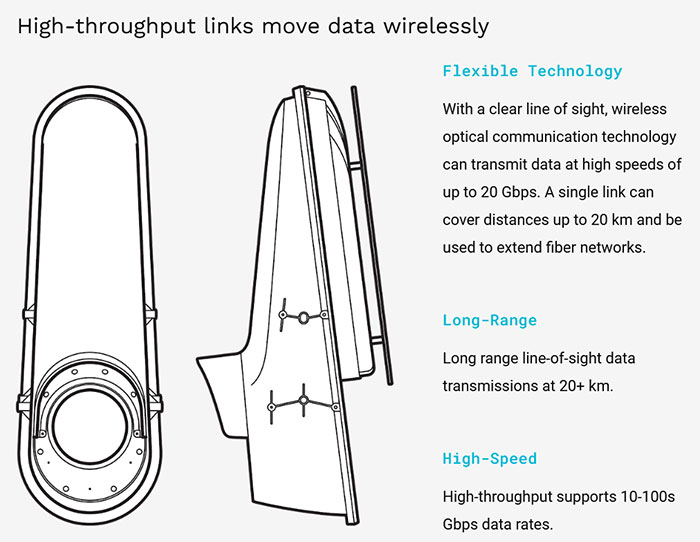
Taara has been tested in more than 12 countries, including India and the Democratic Republic of the Congo, with data transmission of 20 gigabits per second (Gbps). As a point of comparison, SpaceX Starlink Service has a typical maximum average speed of around 100 to 200 megabits per second (Mbps) (equivalent to 0.1-0.2 Gbps). Taara uses a wireless optical communication system (free space optical communication), a data transmission system that transmits data in distant beams of invisible laser from one point to another. The main unit of the Taara service, the Taara Lightbridge, looks like a surveillance camera and can be installed on the rooftop of a building or a base station (BTS) tower. The Taara Lightbridge transmits a laser for your internet connection.
In tests on the Congo River, which separates Kinshasa and Brazzaville, the Taara Lightbridge was able to provide connections between the two countries in just a matter of hours, without the need for digging or laying fiber optic cables. "It's like installing fiber optic cables, but through the air" said Vishal Arora, General Manager of Google Taara, from Wired, Sunday (3/8/2025).
Taara vs. Starlink: A Look at the Differences
Taara and Starlink are both trying to deliver internet to places without it. However, they have two totally different plans and methods of delivering access.
- Technology: Starlink is using radio signals from satellites. Taara is taking a laser approach, from the ground.
- Speed and Latency: Since Taara lasers are only transmitting signals a short distance on the ground, the internet has extremely low latency. This means the internet is very stable and more usable for video calls and gaming.
- Cost and Energy: Taara is cheaper to deploy and run. Each Lightbridge unit uses about 40 watts of power, roughly equivalent to a small lightbulb. This is way less than what satellite systems require. Taara also does not have to pay for expensive trenching, nor does it have to apply for government permits to transmit radio waves.
- Target Market: Starlink is ideal for most remote lengths like in the middle of the ocean or deep within forests. Taara is better at delivering access to "middle mile" areas where they can connect existing fibre optics to a new location that is not easily reached by the wire. Taara does not work with individual users, they work with other internet services providers and government agencies.
Taara will now be able to get more capital from other investors, as an independent company, and grow even faster. They will always have part of the company owned by Alphabet. The Taara team is also working on new inventions. They can make a new chip that can make the Lightbridge unit even smaller. This makes it cheaper and can use it even more places.
A significant part of Taara development also shows that the global competition for signaling into the internet is not limited to space. The Taara team can make what they think is smart and efficient laser technology and want to disrupt connected technologies. Taara proved that the best ideas can be the simplest.